I’m lucky to have a great bunch of writer mates who I’ve known for decades, many of them (deservedly) enormously successful. One of those friends is Lisa Jewell* and this morning on Insta I read Lisa’s post about celebrating her husband’s 60th birthday and maintaining a successful long-term relationship. Among other useful things, she says, “It’s not about romance or butterflies, it’s about pragmatism and humour.”
I couldn’t agree more. Sure, most relationships start off with their own version of romance and/or butterflies, but eventually any relationship involves putting out the bins, getting the dishes done, trying to book a break when none of our schedules align, taking on caring responsibilities for ageing parents, children, friends and each other, and so many mundane daily tasks that our culture’s insistence on date nights** and romantic gestures can make those of us in long-term relationships wonder if we’re doing it right.
Here’s the thing, there is no right. There’s only what you and your partner or partners (not everyone is monogamous and for some ethical non-monogamy works brilliantly) make work for you. This shows up a great deal in relationship therapy. The more I work with clients in relationships as well as with my individual clients and the relationship matters they bring to therapy, the more I realise there is no one-size-fits-all, no sure way to make it work. There’s only what you find works for you, knowing that what works for now, might yet need to change as we change. Because there is always change.
A client who’s been in a very long-term relationship told me recently how their partner always says thank you when they make them a cup of tea. It sounds so simple, but I increasingly think that these are the gestures that really hold a relationship together. These small, easily-missed acts of care can, on a daily basis, add up to a lifetime of feeling valued. And we all need to feel valued, not just for the grand gestures, but ideally for simply being – who we are, as we are.
In my long-term relationship (35 years next month, and neither of us can work out where all that time’s gone!) we say thank you a lot. I don’t recall us making a choice about this, I’m just very aware we do – thank you for driving all that distance, thank you for making a lovely cup of coffee, thank you for doing the garden, thank you for making lunch – you get the idea. I’m not for a moment saying we haven’t had very hard times in our relationship, we definitely have, not least the nine years it took for Shelley’s parents to even meet me, my two cancers, and our childlessness-not-by-choice. Add to that how much harder it was to be out 35 years ago, along with the glacial pace of change towards genuine LGBTQ+ inclusion (clue – we’re not there yet) and we also recognise that some of our relationship longevity has been forged through bloody hard times and our choice, each time, to find a way to make it work.
Humour also shows up in our relationship and with my relationship therapy clients. In longer term relationships, humour seems to matter enormously. Not just finding each other funny (and I do find Shelley very funny, sometimes intentionally, sometimes not) but finding the humour in difficult circumstances. Not always right away but usually, eventually. I don’t mean pretending the hard things aren’t hard – quite the opposite. I think it’s vital that we allow hard things to be exactly as hard as they are. And/but in the hardest times there can also be joy in acknowledging both how bloody hard it is and letting in moments of levity, possibility, and even happiness shine through. Think Cass Elliot’s It’s Getting Better rather than any of the more traditional love songs.
So, as I prepare for my 5th major surgery in two years (hip replacement, ruptured brain aneurysm, 2nd brain surgery to top up the first, knee replacement, 2nd hip replacement in a week) I notice that I am both nervous about a bunch of things – pain, the success of the surgery, my brain surgeries holding, regaining my strength after surgery yet again – and I’m looking forward to enforced time at home with my beloved, to being her hop-along sidekick yet again, to saying thank you even more than usual, to getting back in the sea/pool once I’m healed enough, and to finding the humour in the hard stuff. Because there will also be laughs.
*If you’re not already following Lisa on Instagram, do – she’s very good on writing & the work of being published, and has a splendid line in dog and cat pics.
** I often tell clients that date nights are much over-rated, there’s so much pressure to have a great time, and the more the pressure, the more likely it is to go wrong …

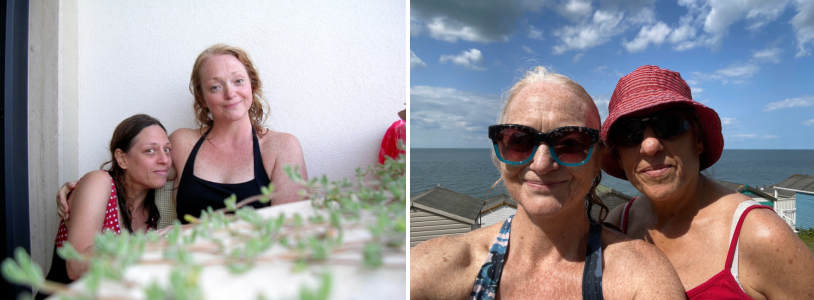
This is 2004 to 2025, so just 21 years instead of our actual 35, but our early photos weren’t digital so …
 Not Writing But Blogging